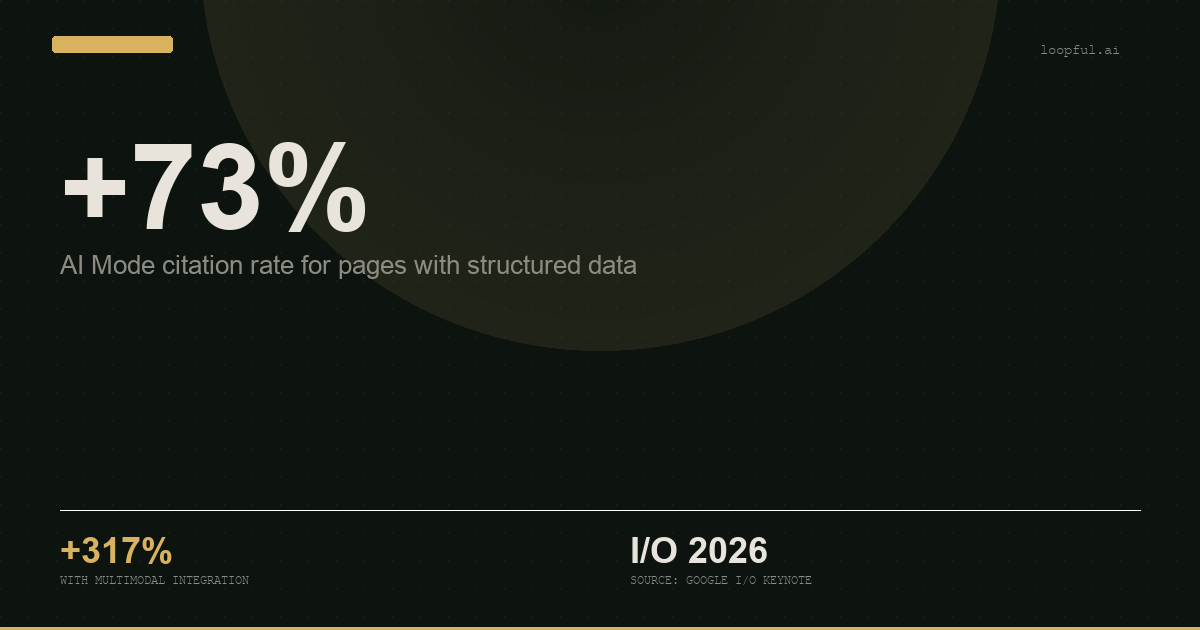
Google I/O 2026 dropped a number that should stop every web team in their tracks: pages with structured data see a 73% higher citation rate in AI Mode. Add multimodal integration and that number climbs to 317%.
That is not a feature announcement. That is a measurement of a shift that has already happened.
Nächster Schritt
Prüfen Sie, ob Ihre Website klar genug für Suchmaschinen und KI-Systeme beschrieben ist.
Nutzen Sie SchemaX, um Ihre wichtigsten Seiten zu scannen und zu sehen, wo Leistungen, Entitäten und Seitenintentionen für Suche und KI noch zu unklar sind.
The stat that changes the conversation
AI Mode — Google's AI-generated answer layer — reads pages the same way an LLM-powered agent does: it extracts meaning, not pixels. Structured data provides unambiguous, machine-readable signals about what a page is. A 73% citation lift means Google's AI is dramatically more likely to surface, quote, and link pages it can understand.
This is not Google rewarding structured data as a ranking signal. It is Google's AI preferring pages that speak its language — because machine-readable meaning is directly usable, while unstructured prose requires interpretation.
+73% citation rate in AI Mode for pages with structured data. +317% with multimodal integration. Source: Google I/O 2026.
Rich results come and go. Schema doesn't.
Also at I/O: FAQ rich results are officially retired as of May 7. If you built content strategies around FAQ carousels in the SERP, that pipeline is over.
This is a pattern worth internalising. Rich results are Google's product — features they ship, maintain, and deprecate on their own timeline. Schema.org markup is the substrate beneath them. FAQ schema did not become less useful when Google stopped rendering FAQ carousels; the structured meaning is still there, still readable, still valuable to every system that ingests it.
Every rich result type carries the same risk: Google controls the rendering, Google controls the lifecycle. The only durable bet is the markup itself.
A word on Universal Cart
I/O also surfaced Universal Cart — a Buy button that appears directly in AI Mode results. Worth being precise about what it is not: it is not schema-driven. Universal Cart requires a Merchant Center account and a UCP profile. Schema.org Product markup is the discovery layer; the transaction infrastructure is a separate, partner-level integration.
This matters because it clarifies roles. Structured data makes you findable and understandable by AI systems. Whether you are purchasable through Google's checkout flow is a different question entirely. Do not conflate the two when scoping what schema work should accomplish.
What AI agents actually care about
The 73% stat does not surprise anyone who has watched agentic traffic emerge over the last 18 months. AI agents — not just Google's, but every LLM-powered agent that browses or indexes your site — are looking for the same thing AI Mode is: structured, typed, machine-readable meaning.
They do not parse breadcrumbs from your CSS. They do not infer your product catalog from your navigation. They read what you have declared explicitly, in a format designed for machines.
Structured data in 2026 is not about SERP features. It is about whether your site is legible to the wave of agentic traffic that is already here — the agents that research on behalf of users, comparison-shop across categories, and populate context windows before a purchase decision gets made.
The thesis holds
SchemaX was built on a specific bet: that the gap between a website and a site that AI can accurately represent is a structural problem, not a content problem. You can have excellent prose and still be invisible to agents if your structured data is missing, wrong, or stale.
Google I/O 2026 confirmed the bet. A 73% citation boost is not a tip for SEOs — it is a measurement of how much machine-legibility already matters, before agentic traffic has fully arrived.
The sites that will be well-represented in AI Mode, in agent context windows, in LLM-powered research tools — they are the ones getting their schema right now. See what that looks like in practice.
Nächster Schritt
Gehen Sie von Theorie zu sauber umgesetzter Sichtbarkeitsarbeit über.
Scannen Sie die Website, prüfen Sie die Vorschläge und spielen Sie Schema im selben Workflow aus, statt maschinelles Verständnis dem Zufall zu überlassen.